
Ventricular septal defect VSD

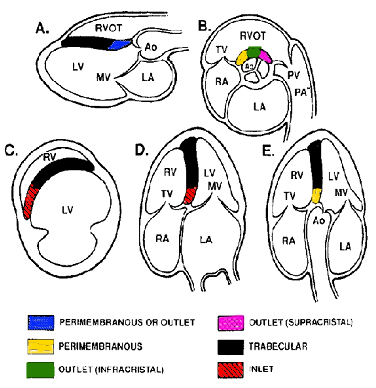
The ventricular septal defect is a common congenital heart defect.  Due to spontaneous closure during growth the VSD is less often seen in adulthood. VSDs are divided into three groups: perimembranous, muscular and subarterial.

The supracristal outlet VSD is called a subarterial VSD. A subarterial VSD can result in progressive aortic valve insufficiency, due to the lack of the cusp support by the outlet portion of the septum. In some cases even small subarterial VSDs should be treated surgically. 

In some circumstances, the septal leaflet of the tricuspid valve can (partially) cover the perimembranous VSD. In these case the images can mimic a septal aneurysm.

Consequences of VSD

The haemodynamic impact of a VSD-shunt is determined by the size of the VSD, and the pressure differences between right and left cardiac chambers. In a large VSD there will be no flow obstruction between the left and right chamber and the pressures will be equal. This high flow phenomenon often results in pulmonary hypertension. As a result the shunt can become bidirectional or even reversed, this is called Eisenmenger syndrome. A moderately large VSD will not very often lead to resistance pulmonary hypertension. However, in cases of a large shunt (>1:2) it can result in volume load for the left chamber. This leads to dilatation of the left atrium and left ventricle.
In small VSDs, there will be a small shunt without significant volume load of the left chamber. The flow velocity measured over the VSD reflects the pressure gradient. Hence in small VSD the gradients will be high (>4m/s) and with large shunts it will be low or even bidirectional in Eisenmenger’.
Ventricular septal rupture (VSR)

Ventricular septum rupture (VSR) represents  a feared and often fatal complication of myocardial infarction. The risk for VSR is highest in the first few days after the occurrence of a STEMI. A VSR usually presents as rapid-onset clinical deterioration with chest pain, acute heart failure and a loud systolic murmur. The diagnosis is confirmed by echocardiography, which is able to differentiate from acute mitral regurgitation and locate and quantify the rupture. The consequent left-to-right shunt may result in signs and symptoms of acute, new-onset right heart failure. Surgical repair is required urgently, but there is no consensus on the optimal timing for surgery . Early surgery is associated with a high mortality rate and a high risk of recurrent ventricular rupture, while delayed surgery allows easier septal repair in scarred tissue, but carries the risk of rupture extension, tamponade and death while waiting for the surgery.

Persistent left superior vena cava (PLSVC)

Persistent left superior vena cava (PLSVC) results from failure of obliteration of the left common cardinal vein, and it typically drains the left jugular and subclavian veins into the right atrium via the coronary sinus. It is the most common variant of thoracic venous drainage, and it is present in 0.5% of the general population. Its incidence increases to 3-10% in patients with congenital heart disease. In 80-90% of the cases a co-existent right superior vena cava is also present, although it can be smaller than usual. Besides coronary sinus, other drainage sites are also possible. In less than 10 percent the persistent PLSVC drains directly into the left atrium or in a pulmonary vein. This type of drainage is almost always associated with other congenital anomalies. It results in right to left shunt and has been associated with cyanosis, paradoxical embolism or brain abscess.

A PLSVC is often an incidental finding during transthoracic echocardiography. It is diagnosed indirectly through recognition of a dilated coronary sinus in parasternal long axis view. The coronary sinus is a circular structure in the atrioventricular groove, located anterior to the pericardium. A dilated coronary sinus must be differentiated from descending aorta, pericardial effusion or pulmonary vein. From four-chamber view with posterior angulation coronary sinus can be viewed in the long axis passing behind the left atrium towards the right atrium.

The differential diagnosis of coronary sinus dilatation includes:

Persistence of left superior vena cava
Any cause of elevated right atrial pressure
Partial anomalous pulmonary venous drainage
Coronary arterio-venous fistula
Unroofed coronary sinus with shunt flow between left atrium and coronary sinus

In case of a dilated coronary sinus contrast injection in the antecubital veins can help establish the diagnosis of a PLSVC. Contrast echocardiography from the left antecubital vein will classically show early coronary sinus opacification, before the right atrium and right ventricle. Imaging is usually done from the parasternal long axis view. In the rare cases of left atrial drainage contrast injection in the left arm will determine opacification of the left atrium. Right antecubital vein contrast injection is followed by a normal sequence of opacification starting from the right atrium and followed by the right ventricle, with no contrast in the coronary sinus.

Therefore, echocardiographic criteria for PLSVC diagnosis are:

Dilated coronary sinus in the absence of elevated right side filling pressure.
Coronary sinus opacification before the right atrium when contrast (“bubble study”) is injected in the left antecubital vein.
Normal sequence of opacification after right arm antecubital vein injection.

Patent ductus arteriosus (PDA)

Patent ductus arteriosus (PDA) is the persistent communication between the proximal left pulmonary artery (LPA) and the descending aorta just distal to the left subclavian artery. It can be associated with a variety of congenital heart disease conditions. A PDA results in a left-to-right shunt and LV volume overload. Presentations of PDA can vary and depend on the functional severity of PDA. A small PDA can present with no LV volume overload and normal pulmonary artery pressures. A moderate PDA can be associated with predominant LV volume overload and/or predominant pulmonary artery hypertension (PAH), with clinical presentations of volume-overloaded left heart failure and/or pressure-overloaded right heart failure respectively. A large PDA can present with Eisenmenger physiology with differential hypoxaemia and cyanosis due to severe PAH, which reverses the shunt direction to a right-to-left shunt. 

Specific clinical findings include a continuous murmur which disappears with development of Eisenmenger syndrome. Echocardiography is the key diagnostic technique and evaluates the degree of LV volume overload, pulmonary artery size and pressures and right heart changes. Additional quantification of LV volumes or pulmonary artery anatomy can be performed with cardiac magnetic resonance imaging or cardiac CT. Right heart catheterisation can be utilised for measurement of cardiac and pulmonary pressures, cardiac output and intracardiac oxygen saturations. Surgical or device closure of PDA represent the preferred therapeutic intervention.    

Atrial septal defect (ASD)

An atrial septal defect (ASD) is a congenital heart defect characterized by an opening in the interatrial septum, the wall separating the left and right atria. This opening allows blood to flow from the left atrium to the right atrium (left-to-right shunt) because left atrial pressure is normally higher than right atrial pressure.
For an echocardiographer, an ASD is important because it can affect:
•    Right heart size and function
•    Pulmonary circulation
•    The risk of arrhythmias
•    The indication for transcatheter or surgical closure
•    The choice of imaging modality

Main Types of ASD

1. Ostium Secundum ASD
This is the most common type (approximately 70–80% of cases).
Location:
At the level of the fossa ovalis in the central portion of the atrial septum.
Echocardiographic findings:
Defect visualized best in subcostal and apical views.
Right atrial and right ventricular enlargement may be present.
Color Doppler demonstrates a left-to-right shunt.
Clinical significance:
Often suitable for transcatheter device closure if adequate septal rims are present.

2. Ostium Primum ASD
Part of the spectrum of atrioventricular septal defects (AVSDs).
Location:
Inferior portion of the atrial septum, adjacent to the atrioventricular valves.
Echocardiographic findings:
Defect located low in the septum.
Frequently associated with a cleft anterior mitral leaflet.
Mitral regurgitation is common.
Clinical significance:
Not suitable for device closure.
Surgical repair is required.

3. Sinus Venosus ASD
Accounts for approximately 5–10% of ASDs.
Locations:
Superior type: near the superior vena cava (SVC) entry.
Inferior type: near the inferior vena cava (IVC) entry.
Echocardiographic findings:
Often difficult to identify on standard transthoracic echocardiography.
Frequently associated with partial anomalous pulmonary venous connection (PAPVC).
Clinical significance:
Transesophageal echocardiography (TEE), cardiac CT, or MRI may be required.
Surgical correction is usually necessary.

4. Coronary Sinus Defect (Unroofed Coronary Sinus)
A rare form of interatrial communication.
Location:
Communication between the left atrium and the coronary sinus.
Echocardiographic findings:
Dilated coronary sinus.
May be associated with a persistent left superior vena cava.
Clinical significance:
Additional imaging is often required for diagnosis.


Summary for the Echocardiographer

ASD Type

Location

Frequency

Suitable for Device Closure?

Ostium Secundum

Fossa ovalis

Most common

Often yes

Ostium Primum

Low atrial septum near AV valves

Less common

No

Sinus Venosus

Near SVC or IVC junction

5–10%

No

Coronary Sinus Defect

Coronary sinus region

Rare

Usually no

The echocardiographer's primary role is to accurately identify the type of ASD, its size, shunt direction, impact on right heart chambers, pulmonary pressures, associated abnormalities, and suitability for transcatheter closure, as these factors directly determine patient management and treatment strategy.

Reference

to be continued

The information above comes from Echocardiografie.nl. Last changed on: 25 June 2026.